Self-Tracking to Surveillance: Quantified Self's Fall

Self-Tracking to Surveillance: Quantified Self's Fall

The Authenticity Tax: How Being Yourself Became Labor

The Vacancy Paradox: Empty Homes and Homelessness

How Engagement Algorithms Turn Social Media Into Outrage

Data Dignity: Should You Own Your Personal Data?

The Great Log-Off: Why Millions Quit Social Media
TL;DR: The U.S. workforce is undergoing a seismic shift: 27% of jobs are now contract or gig positions, up 50% since 2019. While this transformation offers flexibility and higher hourly rates for some, it strips away benefits, stability, and protections for millions. The permanent career is becoming a relic as we all become independent contractors.

Twenty-seven percent. That's the share of all jobs held in 2024 that were either short-term W-2 positions or 1099 contractor roles, according to ADP Research's analysis of 26 million employees. For context, that's roughly one in four American workers who don't have what their parents would recognize as a "real job." The trajectory is even more striking: independent contractor employment surged 50% between 2019 and 2024, accelerated by the pandemic's forcing function on remote work and digital platforms. We're witnessing something more profound than a temporary shift. The stable, benefits-laden career that defined the American middle class for three generations is becoming the exception, and contract work is becoming the rule.
This isn't just about Uber drivers and DoorDash couriers, though platform work has exploded to include 7 million Americans contributing $212 billion to the economy. It's about the software engineer hired project-to-project, the nurse working through a staffing agency, the consultant bouncing between three clients simultaneously. The transformation cuts across industries, income levels, and skill sets. What started as flexibility has evolved into something more ambiguous: a labor market where the idea of permanent employment feels increasingly quaint.
The statistics paint a picture that defies simple narratives. Independent contractors earn a median $25 per hour, outpacing the overall workforce's $23 median, while temporary workers lag at $15. But here's the complication: that $25 hourly rate doesn't include employer-paid health insurance, retirement contributions, or payroll taxes. When the UC Berkeley Labor Center crunched the numbers for rideshare drivers, they found that after accounting for expenses, Uber and Lyft drivers earned $9.09 per hour, while delivery workers made $13.62.
The scope keeps expanding. Fifty-seven million Americans now freelance, contributing $1 trillion annually to GDP, roughly 5% of the total economy. Globally, the gig economy market hit $556.7 billion in 2024 and is projected to reach $2.1 trillion by 2033. These aren't side hustles anymore. For many, this is primary employment. Though 56% of gig workers report taking these jobs as supplemental income, that still leaves nearly half who depend on contract work as their main source of earnings.
The business case for contractors is brutally straightforward: cost reduction. Hiring a contractor instead of an employee saves companies 20-40% when you factor in benefits, payroll taxes, unemployment insurance, and overhead. A W-2 employee costs their salary plus 25-40% more for benefits. A 1099 contractor? You pay the rate and walk away. No health insurance premiums, no 401(k) matching, no paid time off, no payroll taxes split with Uncle Sam.
The flexibility argument isn't just corporate spin, though. Companies operating in volatile markets or scaling rapidly genuinely need the ability to adjust headcount quickly. Hiring a full-time employee represents a long-term commitment with significant exit costs if things don't work out. Contractors provide elasticity: scale up for a product launch, scale down when the project ends. For startups and project-based businesses, this isn't optional, it's existential.
A W-2 employee costs their salary plus 25-40% more for benefits. A 1099 contractor? Companies pay the rate and walk away with no additional obligations.
Technology lowered the transaction costs of this arrangement dramatically. Platforms like Upwork, Fiverr, and Toptal created global marketplaces where companies can find specialized talent in hours rather than months. The friction that once made contract hiring difficult vanished. Need a Python developer for three months? Post the job at 9 AM, interview candidates by noon, have someone working by tomorrow. The infrastructure that enabled this shift included not just job platforms but also payment processors, project management tools, and communication software that make remote contract work seamless.
Traditional employment bundled together three distinct things: labor, stability, and benefits. You sold your time and skills, and in return you got not just a paycheck but also health insurance, retirement savings, paid vacation, sick leave, and a reasonable expectation that you'd still have this job next year. The gig economy unbundled that package. Now you sell your labor and get paid. Everything else? That's your problem.
Only 40% of gig workers have health insurance coverage, leaving 60% uninsured or paying full freight on the individual market. Retirement savings become entirely self-directed. While contractors can contribute up to $70,000 annually through Solo 401(k) plans (far exceeding traditional 401(k) limits), that assumes you have $70,000 in surplus income and the financial sophistication to set up and manage these accounts. Most gig workers don't. They're focused on next month's rent.
The volatility factor is harder to quantify but impossible to ignore. Low-income workers experience the most earnings instability, with hours and income fluctuating wildly week to week. That predictability you took for granted with a salaried job, knowing you'd have $3,500 landing in your account on the 15th of every month? Gone. Replaced by a spreadsheet where you're constantly calculating if you'll make rent, trying to project earnings three months out with no real basis for the estimates.
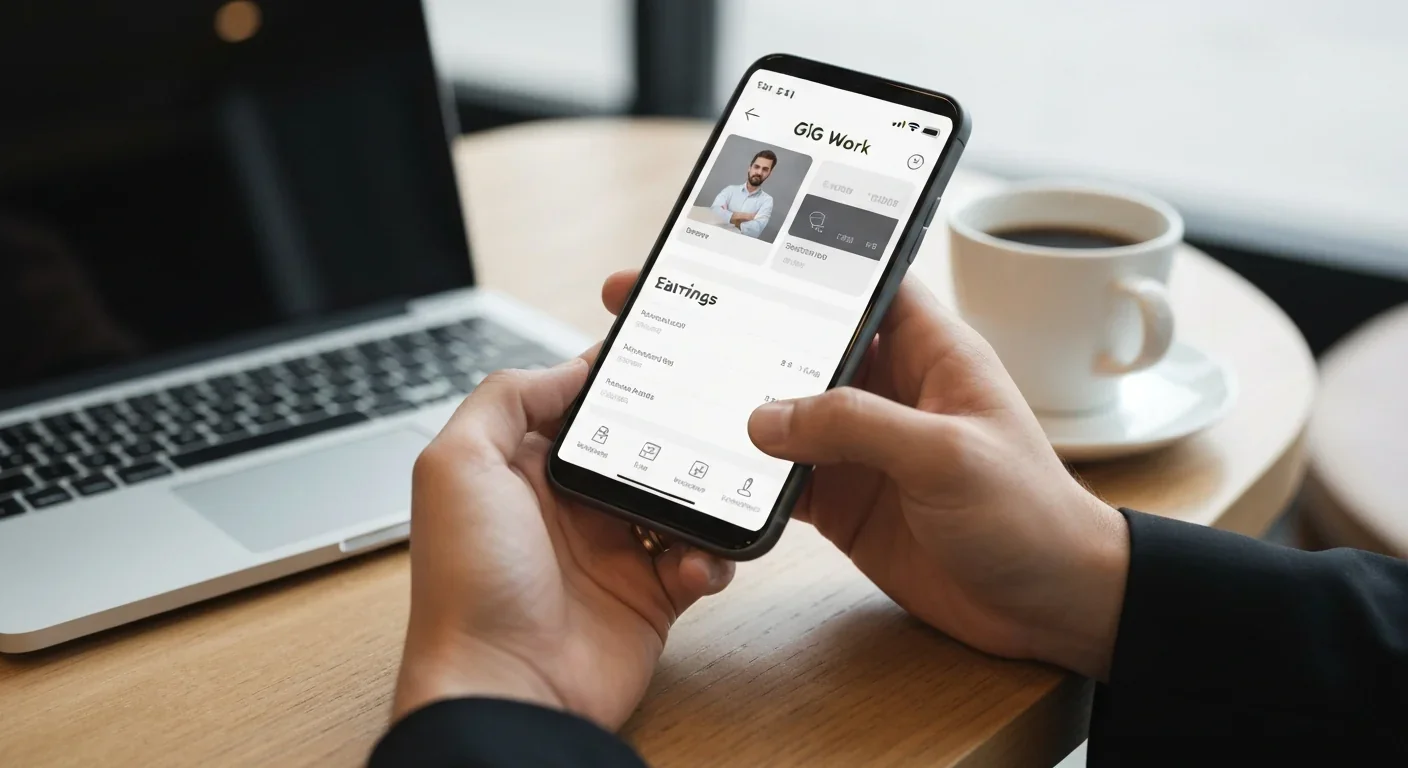
The gig economy doesn't distribute itself evenly across the population. Independent contractors tend to be older, more likely to be men, and concentrated in finance and business services. Gig professionals aged 55-64 earn an average hourly rate of $36, significantly higher than younger cohorts. These are often established professionals who accumulated skills and networks over decades of traditional employment, then shifted to high-end consulting.
The temporary worker category skews young, overrepresented in leisure, hospitality, and administrative roles with high seasonal demand. These are the workers with the least leverage, bouncing between short-term W-2 gigs that provide minimal stability and no benefits.
Race adds another layer. Black and Latinx workers comprise 29% of the overall workforce but represent 42% of workers for Uber, Lyft, and other digital labor platforms. The gig economy's promise of opportunity and flexibility looks different when you're starting from a position of systemic disadvantage in the traditional job market.
Gen Z brings an entirely different mindset to this transformation. Fifty-five percent of ZayZoon's customer base is 34 years old or younger. For this cohort, the concept of working at one company for 30 years sounds less like stability and more like a prison sentence. They watched their parents get laid off after decades of loyalty. They graduated into the 2008 financial crisis or the pandemic recession. Trust in corporate loyalty was DOA before they even entered the workforce.
"82% of gig workers actively chose this model rather than being forced into it by necessity."
- LaborStrong Research
The data suggests 82% of gig workers actively chose this model rather than being forced into it by necessity. That seems high, possibly influenced by survivorship bias in the surveys, but it reflects something real: a significant portion of workers prefer the autonomy and flexibility of contract work despite its drawbacks. The average monthly salary for gig workers is nearly $7,000, roughly $2,000 higher than traditional employees, at least for those succeeding in the model.
Young workers have adapted by treating their entire career as a portfolio rather than a progression up a single ladder. They maintain multiple income streams, constantly network, invest in skill development, and build personal brands. The entrepreneurial mindset isn't optional; it's survival.
Transportation and delivery services represent ground zero. Platform companies like Uber, Lyft, DoorDash, and Instacart built their entire business models on classifying workers as independent contractors. Full-time rideshare drivers provide 49% of all passenger trips in California, yet the companies insisted these weren't really employees in any meaningful sense.
Creative industries followed close behind. Graphic designers, writers, photographers, video producers, the entire creative services ecosystem shifted toward project-based work. Traditional full-time creative positions at agencies and corporations got replaced by a rotating cast of freelancers. The work didn't disappear; it just got outsourced to contractors.
IT and software development embraced the contract model aggressively. Tech companies realized they could hire developers on a per-project basis, tapping global talent pools and avoiding the massive overhead of permanent engineering teams. Healthcare joined the party through staffing agencies that supply nurses and other clinical staff on contract terms to hospitals and clinics.
Even sectors that seemed immune are cracking. Education has moved toward adjunct faculty instead of tenure-track positions. Legal services increasingly use contract attorneys for document review and research. Marketing departments outsource everything from content creation to social media management.

The classification question became the central battleground because everything hinges on it. If you're an employee, you get minimum wage protections, overtime pay, unemployment insurance, workers' compensation, anti-discrimination protections, and the right to unionize. If you're a contractor, you get none of that. Companies save billions by keeping workers in the contractor category.
California's AB5 law, enacted in 2019, tried to force reclassification by implementing the "ABC test" for determining employment status. Companies had to prove that workers were free from their control, performing work outside the company's usual business, and independently established in that trade. Platform companies spent more than $200 million lobbying to place Proposition 22 on the ballot, which carved out an exemption for app-based transportation and delivery companies.
If platform workers in Texas had been classified as employees, the state could have collected over $111 million in unemployment insurance contributions between 2020 and 2022 alone.
The legal wrangling continues. Uber settled a class-action lawsuit for $20 million, agreeing to reclassify drivers in California and Massachusetts. Uber and Lyft could owe California gig workers billions in a wage theft case. California imposes civil penalties of $5,000 to $25,000 per violation for willful misclassification.
If platform workers in Texas had been classified as employees, the state could have collected over $111 million in unemployment insurance contributions between 2020 and 2022. Multiply that across all fifty states and you start to see why this matters to governments. It's not just about worker protections; it's about massive amounts of tax revenue.
Some states are trying to thread the needle between contractor flexibility and employee protections through portable benefits systems. Wisconsin's Portable Benefits Bill ensures gig workers receive portable health insurance and paid time off that follows them from job to job rather than being tied to a single employer. It's an acknowledgment that the gig economy isn't disappearing, so maybe we need new structures instead of forcing everything back into the old employment box.
Massachusetts took a different approach, passing Question Three in November 2024, which permits rideshare drivers to form unions and collectively bargain. This adapts the union model to gig work, allowing workers to negotiate collectively even if they're not technically employees. Whether this survives legal challenges remains to be seen.
The European Union has been more aggressive, with countries like the UK reclassifying Uber drivers as workers entitled to minimum wage and holiday pay. The regulatory divergence creates headaches for platform companies operating internationally, but it also creates natural experiments in different policy approaches.
AI and automation are accelerating the transformation in unexpected ways. Upwork's Uma AI automates proposal drafting and project matching, reducing time to win jobs by 30% for top-performing freelancers. That makes contract work more efficient for high-skilled workers who can leverage these tools. It also makes it easier for companies to find and vet contractors, reducing the traditional advantages of maintaining an in-house team.
Platforms themselves evolve toward taking a larger cut. Upwork charges $0.15 per Connect token, with most job postings requiring 1-6 tokens. The economics of platform work increasingly resemble landlordism: the platform owns the marketplace and extracts rent from every transaction. Workers get access but surrender a growing percentage of their earnings.
The technology that enabled the gig economy also makes it possible for companies to monitor, measure, and control contractor behavior in ways that blur the legal distinction between employee and contractor. Algorithmic management means the app tells you when to work, where to go, what price to accept. That looks suspiciously like employment supervision, but the legal framework hasn't caught up.
If you're under 40, you'll likely spend significant portions of your career as a contractor whether you plan to or not. The infrastructure you need includes: tax software that handles quarterly estimated payments, accounting systems to track deductible expenses, health insurance from the individual marketplace, self-directed retirement accounts, professional liability insurance, and an emergency fund that covers at least six months of expenses.
The skill requirements shift. Technical competence in your field becomes table stakes. You also need sales ability to continuously find clients, marketing skills to build a personal brand, financial literacy to manage irregular income, and negotiation tactics to get decent rates. Being good at your job isn't enough. You need to be good at running a one-person business that happens to do your job.
"Freelancers work an average of 43 hours per week, with 57% reporting more than 40 hours."
- NorthOne 2025 Gig Economy Report
Freelancers work an average of 43 hours per week, with 57% reporting more than 40 hours. The flexibility promised often translates to working evenings and weekends because you're constantly hustling for the next gig. The boundary between work and personal life dissolves when your laptop is your office and every hour not spent working is an hour not earning.
Some projections estimate 50% of the workforce will be gig or contract by 2030. That might be optimistic (or pessimistic, depending on your perspective), but the direction is clear. The global gig economy is projected to reach $2.1 trillion by 2033, growing at 16% annually. These aren't side hustles; this is the core of how work gets done.
The question isn't whether contract work will become more prevalent. That ship sailed. The questions are: Will we build new institutions to provide stability, benefits, and worker power in a contractor-based economy? Will portable benefits become the norm? Will contractors gain collective bargaining rights? Can we create social safety nets that work for people whose income fluctuates wildly month to month?
Or will we continue pretending that gig work is temporary until everyone figures out how to get a "real job," while the percentage of workers with real jobs keeps shrinking?
The social contract between employers and employees that defined the 20th century is being rewritten in real time. Whether the new version provides security, dignity, or opportunity depends entirely on choices we make now.
The permanent gig is here. We're all independent contractors now, we just haven't all admitted it yet. The social contract between employers and employees that defined the 20th century is being rewritten in real time. Whether the new version provides anything resembling security, dignity, or opportunity depends entirely on choices we make in policy, business practices, and how we organize work in the next few years.
What worked for your parents' generation, the stable career with benefits and a pension, is becoming historical artifact. The new normal is constant adaptation, self-directed everything, and treating yourself as a business. That's either liberating or terrifying depending on your resources, skills, and tolerance for uncertainty. For most people, it's probably both.


Project Orion was a real 1960s program to reach other stars by detonating 800 nuclear bombs behind a spacecraft. The physics worked and the engineering was feasible, but the 1963 nuclear test ban treaty killed it. It remains the most credible interstellar spacecraft ever designed.

The locus coeruleus, a tiny brainstem structure, degenerates decades before Alzheimer's symptoms appear. Its loss cripples the brain's inflammation control, waste clearance, and sleep regulation. New imaging tools and noradrenergic therapies offer hope for early detection and prevention.
Research shows the sharing economy often increases total resource consumption through the Jevons paradox and rebound effects. Ride-sharing adds billions of vehicle miles, co-working spaces use more energy per worker, and diffused responsibility erodes conservation behavior. Breaking the paradox requires congestion pricing, accountability design, and matching sharing models to appropriate resource types.

Psychological reactance theory explains why banning or restricting things makes people want them more. From Prohibition to the Streisand effect to scarcity marketing, research shows that threatening people's freedom reliably backfires, and autonomy-supportive communication is far more effective.

A carnivorous pitcher plant in Borneo evolved to house bats instead of trapping insects, gaining up to 95% of its nitrogen from bat guano. The plant even built an ultrasonic reflector to help bats find it, revealing that carnivory in plants is a flexible spectrum.
The quantified self movement began as a hacker-ethos pursuit of personal insight, but corporate wearables now funnel biometric data to employers, insurers, and data brokers. With 81% of Americans wrongly believing health apps are HIPAA-protected, a regulatory void enables health data to be sold for pennies while generating anxiety instead of empowerment.

CXL memory pooling lets servers dynamically share DRAM over a cache-coherent interconnect, eliminating the 40% stranded memory waste in data centers. With commercial hardware now shipping and Azure deploying CXL cloud instances, this technology promises to cut memory costs by 50% while enabling composable infrastructure.

Loading featured articles...