Self-Tracking to Surveillance: Quantified Self's Fall

Self-Tracking to Surveillance: Quantified Self's Fall

The Authenticity Tax: How Being Yourself Became Labor

The Vacancy Paradox: Empty Homes and Homelessness

How Engagement Algorithms Turn Social Media Into Outrage

Data Dignity: Should You Own Your Personal Data?

The Great Log-Off: Why Millions Quit Social Media
TL;DR: Modern institutions have become dominated by quantitative metrics at the expense of professional judgment. From schools teaching to tests to hospitals chasing satisfaction scores, the obsession with measurement creates gaming, defensive behavior, and erodes expertise - turning the metric itself into the mission.

The hospital executive stared at the dashboard. Patient satisfaction scores: 92%. Length of stay: down 18%. Readmission rates: within target. On paper, the emergency department was thriving. In reality, doctors were discharging borderline patients early to hit metrics, nurses spent more time documenting than caring, and the "satisfied" patients often returned within weeks because their conditions weren't fully treated. Nobody questioned the numbers because the numbers looked good.
This is Goodhart's Law in action: when a measure becomes a target, it ceases to be a good measure. What began as a critique of British monetary policy in the 1970s has become the defining paradox of modern institutional life. We live in what sociologist Michael Power called an audit society, where quantitative metrics, performance indicators, and standardized assessments have replaced professional judgment as the primary basis for evaluating quality and effectiveness.
The transformation didn't happen overnight. It emerged from legitimate concerns about accountability, transparency, and fairness. But somewhere between measuring performance and managing by metrics alone, institutions crossed a threshold. Today, 90% of large corporations use KPI-based performance management systems. Schools organize entire curricula around standardized test preparation. Healthcare providers make clinical decisions with one eye on patient satisfaction scores that affect Medicare reimbursement. Police departments face pressure to manipulate crime statistics to demonstrate effectiveness.
The audit society promised objectivity and efficiency. Instead, it often delivers gaming, tunnel vision, and the systematic erosion of the expertise it was meant to measure.
The roots of today's metric obsession trace back to the New Public Management reforms of the 1980s and 1990s. Faced with fiscal crises and public skepticism about government effectiveness, policymakers imported private sector management techniques into public services. The logic seemed sound: if businesses could improve efficiency through measurement and accountability, why couldn't schools, hospitals, and government agencies?
The answer, it turns out, is complicated. Private companies measure success primarily through profit, a relatively straightforward metric. Public institutions serve multiple, often conflicting goals. A school must educate students, yes - but also foster creativity, build character, address inequality, and prepare citizens for democracy. A hospital must treat illness, but also promote wellness, conduct research, train future doctors, and serve as a safety net for the vulnerable.
When you try to capture this complexity in a dashboard, something gets lost. The measurable drives out the meaningful. Teaching to the test replaces genuine learning. Hitting hospital discharge targets takes precedence over patient outcomes. Police focus on crime statistics rather than community safety.
When a measure becomes a target, it ceases to be a good measure. This seemingly simple principle - Goodhart's Law - has become the defining paradox of modern institutions, from hospitals to schools to corporate boardrooms.
Michael Power's 1997 book The Audit Society identified this shift early. He observed that auditing had expanded from financial accounting into a generalized "ritual of verification" applied across society. Organizations spent enormous resources producing evidence of their quality for external auditors, often at the expense of actually improving that quality. The audit process itself became the goal, not the outcomes it supposedly measured.
What's striking is how similar the patterns look across completely different sectors. Teachers, doctors, police officers, and business managers all report the same experience: metrics that were supposed to support their professional judgment instead constrain it, metrics designed to ensure accountability instead create incentives for manipulation, and the pressure to perform well on measurements crowds out the deeper mission that drew them to their professions.

Walk into almost any public school in America, and you'll find a calendar structured around testing. Not just the tests themselves - entire months devoted to test prep, practice tests, test-taking strategies. Research shows teachers in high-stakes testing environments spend three to four weeks of school time on special test preparation, time that increases as test dates approach.
The pressure is measurable. Surveys reveal that teachers report mean pressure scores of 3.59 from district administrators and 3.63 from media regarding test performance. One teacher captured the experience: "Teachers feel jerked around. The test dictates what I will do in the classroom. If you deviate from the objectives, you feel guilty."
"Teachers feel jerked around. The test dictates what I will do in the classroom. If you deviate from the objectives, you feel guilty."
- Teacher survey respondent, Effects of Standardized Testing study
This isn't teachers being dramatic. Their livelihoods depend on student test scores. In many districts, teacher evaluations, merit pay, and even job security tie directly to standardized test results. Principals face similar pressure from superintendents, who answer to school boards, who respond to newspaper rankings and property values influenced by school ratings. The entire system aligns around a single, narrow measure of educational quality.
The consequences ripple outward. Non-tested subjects get marginalized - art, music, physical education, social studies all shrink to make room for test-prep time. Teachers neglect material the external test doesn't include: creative projects, higher-order problem solving, anything that can't be bubbled in on a Scantron sheet. The curriculum narrows not because teachers think this serves students, but because the institutional incentives point nowhere else.
What makes this particularly insidious is that test scores can improve while actual learning declines. Schools get better at producing high test scores through intensive coaching without necessarily improving students' deeper understanding, critical thinking, or long-term knowledge retention. The metric goes up; the mission gets lost.
The pedagogy of standardized testing doesn't just change what gets taught - it fundamentally alters the relationship between teacher and student. Professional educators become deliverers of standardized content, their expertise reduced to following scripts designed by distant test-makers who've never met their students. The craft of teaching, honed through years of experience and deep knowledge of individual learners, gets steamrolled by one-size-fits-all accountability.
Interestingly, the pressure manifests differently depending on context. High-SES schools face stronger media and community pressure to maintain rankings and property values. Low-SES schools experience more administrative scrutiny, with threats of takeover or closure if scores don't improve. But regardless of the source, teachers across all contexts report the same loss of professional autonomy, the same sense that external metrics have taken control of their classrooms.
Since 2012, Medicare has tied hospital reimbursement to patient satisfaction scores through the HCAHPS survey. The policy aimed to make healthcare more patient-centered, ensuring that hospitals attended not just to clinical outcomes but to the patient experience. The unintended consequences reveal everything wrong with metric fixation.
Consider length of stay (LOS), a common hospital performance metric. Reducing LOS seems obviously good - patients get home faster, costs decline, beds open for new patients. But hospitals aggressively pursuing this metric have inadvertently discharged patients prematurely, leading to increased emergency readmissions. The metric improved; patient outcomes didn't.
Or take patient satisfaction scores themselves. Research shows higher satisfaction correlates with up to 30% reduction in readmission rates, suggesting genuine value. But when satisfaction scores affect reimbursement, they stop measuring patient experience and start driving defensive behavior. Doctors prescribe antibiotics for viral infections because patients expect them. Nurses spend more time documenting patient interactions than having them. Providers avoid difficult but necessary conversations about treatment limitations because they might lower satisfaction ratings.

The paradox deepens: HCAHPS measures patient experience, not satisfaction - but most hospitals treat it as a satisfaction survey because that's what affects their bottom line. The distinction matters. Experience captures objective aspects of care: were you informed about medications, did nurses respond to call buttons, was the room clean? Satisfaction is subjective: did you like your doctor, feel comfortable, enjoy the food? By conflating the two, the metric incentivizes hospitals to maximize patient happiness rather than optimize clinical care.
This creates particularly perverse incentives around pain management. Patients who receive more pain medication often report higher satisfaction scores. In the context of an opioid epidemic, the pressure to maintain satisfaction scores has contributed to overprescribing. Doctors face a choice: provide appropriate, conservative pain management and risk lower scores, or prescribe more aggressively and protect their metrics. The quality metrics designed to improve care instead push providers toward practices that harm public health.
Defensive medicine flourishes when metrics trump judgment. Physicians order unnecessary tests not because clinical judgment suggests they're needed, but because they provide documentation and cover if outcomes turn bad. Every interaction becomes a potential data point rather than a healing relationship.
Defensive medicine flourishes in this environment. Physicians order unnecessary tests and procedures, not because clinical judgment suggests they're needed, but because they provide documentation and cover if outcomes turn bad. Every interaction becomes a potential data point, every decision a chance to hit or miss a target. The art of medicine - the subtle judgment calls that come from experience, the ability to read a patient's unstated concerns, the wisdom to know when less intervention serves better than more - all this gets squeezed out by protocols designed to optimize metrics.
Nurses report similar frustrations. They entered healthcare to care for patients, but spend increasing time at computer terminals documenting that care for quality measurement purposes. The irony is palpable: less time caring, more time proving you're caring. The metric demands evidence; the mission demands presence. These aren't always compatible.
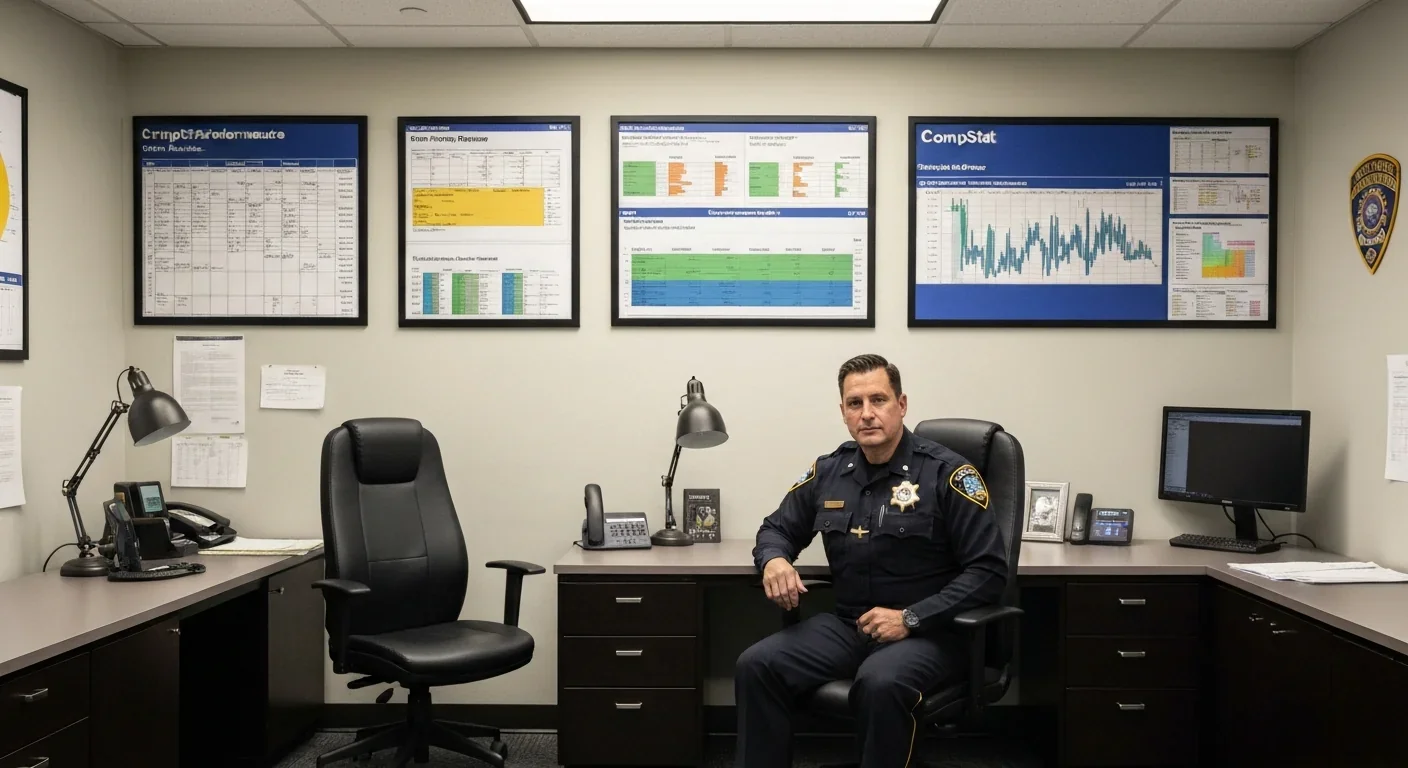
Police departments face enormous pressure to demonstrate effectiveness through crime statistics. The CompStat system, pioneered in New York City in the 1990s, revolutionized policing by making precinct commanders accountable for crime trends in their areas. It also created powerful incentives to manipulate the numbers.
Recent investigations reveal the scope of the problem. A House Oversight Committee report found that Washington D.C.'s police chief deliberately manipulated crime data, with thousands of cases misclassified to show declining crime rates. Federal probes uncovered similar patterns in other cities, with serious crimes downgraded to lesser offenses, reports discouraged or lost, and statistics systematically distorted to meet political demands.
The manipulation works both ways. When departments want to justify increased resources or demonstrate the need for tough-on-crime policies, statistics can be selectively emphasized or reclassified upward. When political pressure demands evidence of declining crime, the same flexibility works in reverse. The NYPD faced accusations of statistical manipulation that not only distorted crime trends but reinforced racial disparities in policing.
What gets lost in this numbers game is actual public safety. Officers respond not to community needs but to statistics that affect their department's performance ratings. "Clearance rates" - the percentage of crimes solved - become more important than whether the right person was charged. Arrest quotas drive stops and searches that damage police-community relations. The metric becomes the mission.
CompStat introduced valuable tools for identifying crime patterns and allocating resources. But when those tools become the primary measure of police effectiveness, professional judgment erodes. Officers learn to game the system, commanders learn to massage the data, and the connection between statistics and reality frays. The public receives reports showing crime declining while feeling less safe, because the numbers reflect institutional incentives rather than lived experience.
Corporate America embraced Key Performance Indicators with religious fervor. If you can't measure it, you can't manage it - or so the consultants promised. Today, businesses track everything: customer satisfaction scores, employee engagement indices, productivity metrics, quality ratings, sales targets, and hundreds of subsidiary measures. Dashboards proliferate, executives demand real-time data, and entire departments exist solely to feed the measurement machine.
The KPI-based performance management systems that 90% of large corporations now use weren't supposed to replace managerial judgment. They were meant to inform it, providing objective data to supplement experience and intuition. But predictably, the measurable drove out the meaningful. Managers optimize for KPIs because that's what determines bonuses and promotions. Employees learn to hit targets even when doing so contradicts the company's stated mission.
Sales teams make this visible. Set a monthly revenue target, and salespeople push deals forward to close before month-end, even if waiting would better serve the customer. Set a target for new customer acquisition, and they'll neglect existing relationships to chase new names. Measure calls per hour, and quality suffers as speed takes priority. Each metric in isolation makes sense; collectively, they create a system that rewards gaming over genuine performance.
The technology sector provides particularly stark examples. When Facebook measured success by "engagement" and "time on site," algorithms optimized for addiction and outrage because those metrics went up. When Wells Fargo set aggressive targets for new accounts opened, employees created millions of fake accounts to hit their numbers. When Boeing faced pressure to meet production schedules and cost targets, safety concerns got overridden - with catastrophic results.
"Any observed statistical regularity will tend to collapse once pressure is placed upon it for control purposes."
- Charles Goodhart, economist
These aren't isolated scandals; they're predictable outcomes of metric fixation. When an organization elevates measurement above mission, when hitting the number matters more than whether the number captures anything meaningful, the system inevitably gets gamed. Employees aren't irrational or immoral for doing this - they're responding rationally to the incentives their organizations create.
The psychological impact on workers mirrors what teachers and doctors report. Professionals enter fields because they believe in the mission: building great products, serving customers, creating value. But when their daily work gets reduced to hitting arbitrary numerical targets, meaning drains away. The spreadsheet replaces purpose. The metric becomes the job.
Living inside the audit society exacts a heavy psychological price. Professionals across sectors report similar experiences: loss of autonomy, erosion of meaning, constant surveillance, and the exhausting cognitive dissonance of knowing the metrics don't actually measure what matters while being forced to optimize for them anyway.
The paradox of public performance management captures this perfectly. Organizations implement performance measurement systems to improve outcomes. But the measurement process itself consumes resources that could go toward the mission. Workers spend more time documenting their work than doing it. Managers spend more time reviewing metrics than developing their teams. The verification ritual overtakes the thing being verified.
This creates what scholars call "metric fatigue" - a demoralized state where professionals stop believing in the systems they're measured by. They comply externally while internally checking out, going through the motions of hitting targets without engagement or investment. The organization gets the numbers it wants; it loses the discretionary effort and intrinsic motivation that actually drive performance.
Trust erodes in multiple directions. Workers stop trusting leadership that prioritizes metrics over mission. Leadership stops trusting professionals to exercise judgment, demanding more surveillance and verification. Customers or clients stop trusting institutions whose behavior seems driven by hitting numbers rather than serving needs. The audit mentality, ironically, creates the very accountability problems it was meant to solve.
The organizational impacts compound over time. Metric-driven cultures systematically push out experienced professionals who remember when judgment mattered, replacing them with rule-followers who color inside the lines. Institutional knowledge gets lost. Innovation declines because creative experimentation doesn't fit neatly into KPI frameworks. Risk aversion takes over because any failure gets measured, recorded, and held against you.
Perhaps most concerning is how measurement systems affect who enters these professions. Young people considering teaching, healthcare, or public service increasingly ask: will I actually get to do the work I care about, or will I spend my career optimizing spreadsheets? The audit society doesn't just change how we work - it shapes who chooses to work in fields that matter most to social wellbeing.

Given all these problems, why does metric fixation persist and even intensify? The answer lies in metrics' powerful appeal to different constituencies, each with legitimate but ultimately narrow interests.
For politicians and policymakers, metrics provide political cover. Defending budget allocations or policy choices becomes easier when you can point to objective data showing success. Numbers create the appearance of scientific management, even when the underlying complexity resists quantification. And when things go wrong, metrics allow blame to be displaced onto systems rather than individuals.
For executives and administrators, metrics enable control at scale. You can't personally observe thousands of employees or dozens of facilities, but you can track their KPIs. Metrics create the illusion that you're managing effectively, that you have your finger on the pulse of the organization. The dashboard becomes a substitute for actual knowledge of operations.
For auditors and consultants, metrics are the product. The future of auditing points toward ever more sophisticated performance measurement systems, creating lucrative opportunities for those who design, implement, and validate them. An entire industry has grown up around organizational measurement, with incentives to expand rather than question the practice.
For the public, metrics promise transparency and accountability. Rankings let parents choose schools, patients select hospitals, citizens evaluate government services. The fact that these rankings often measure the wrong things, or incentivize harmful behaviors, gets obscured by the reassuring solidity of numbers.
This creates a trap. Each actor has rational reasons to support measurement systems, even while collectively those systems undermine institutional effectiveness. The benefits concentrate (politicians get cover, executives get control, consultants get paid) while the costs disperse across organizations and society. Classic collective action problem.
Metrics appeal to a deep human desire for certainty and simplicity. Professional judgment is messy, subjective, hard to evaluate. Numbers feel objective, comparable, definitive - even when that certainty is an illusion.
Metrics also appeal to a deep human desire for certainty and simplicity. Professional judgment is messy, subjective, hard to evaluate. Numbers feel objective, comparable, definitive. The fact that this certainty is often illusory - that the numbers reflect assumptions, gaming, and measurement artifacts as much as underlying reality - doesn't diminish their psychological appeal.
While Goodhart's Law describes how metrics lose value when they become targets, Campbell's Law explains what happens next: "The more any quantitative social indicator is used for social decision-making, the more subject it will be to corruption pressures and the more apt it will be to distort and corrupt the social processes it is intended to monitor."
This is darker than mere gaming. Gaming implies clever optimization within rules - teaching to the test, discharging patients early, hitting sales quotas through creative tactics. Corruption means the metric actively destroys what it measures. The indicator doesn't just lose reliability; it actively harms the underlying reality.
We see this in education when test-score pressure leads to outright cheating scandals, with administrators and teachers changing student answers. In healthcare when hospitals "cherry-pick" healthier patients to improve outcome statistics while avoiding difficult cases. In business when the relentless focus on quarterly earnings drives executives to accounting fraud, stock manipulation, and decision-making that hollows out companies while pumping up short-term metrics.
The gaming spiral works like this: initial metrics produce useful information, so organizations increase reliance on them. This creates stronger incentives for gaming, which degrades data quality. Organizations respond by adding more metrics and verification systems, increasing the burden without improving reliability. Professionals develop more sophisticated gaming strategies. Trust declines further, triggering additional surveillance. The system collapses under its own weight while the original mission fades from view.
Breaking this spiral requires admitting that some things can't be meaningfully quantified, that professional judgment must play a central role in evaluation, and that the costs of measurement systems can exceed their benefits. These are difficult admissions for audit cultures to make.
The problems with metric fixation don't mean measurement is worthless or that accountability doesn't matter. The challenge is finding approaches that preserve the benefits of transparency while avoiding the pathologies of metric dominance.
Evidence-based practice offers one model. Rather than treating metrics as targets, use them as feedback to inform professional judgment. Teachers should understand what standardized tests reveal about student learning - but shouldn't organize entire curricula around test scores. Doctors should attend to patient satisfaction - but shouldn't let it override clinical judgment. Police should track crime statistics - but shouldn't let them determine operational priorities.
This requires cultural shifts in how organizations use data. Metrics should be diagnostic, not deterministic. They should trigger investigation ("Why are these numbers moving?") rather than automatic consequences ("You missed your target, you're fired"). The assumption should be that metrics provide partial, imperfect information that must be interpreted with contextual knowledge and professional expertise.
Several principles can guide this rebalancing. First, measure outcomes, not just outputs. Don't count the number of patients seen (output) without tracking whether they got better (outcome). Don't measure arrests without examining whether communities feel safer. Outcome measurement is harder and slower, but it's what actually matters.
Second, use multiple measures to capture complexity. No single metric can represent educational quality, healthcare effectiveness, or business performance. A portfolio of indicators, some quantitative and some qualitative, provides a fuller picture. When metrics conflict - when patient satisfaction and clinical outcomes point different directions - that conflict itself contains valuable information.
Third, give professionals voice in designing measurement systems. The people doing the work understand its complexity and can identify what metrics might usefully inform practice versus which will simply incentivize gaming. Participatory design produces better measurement and greater buy-in.
Fourth, protect space for professional judgment. Some decisions should explicitly not be metric-driven. Tenure decisions in universities, for example, shouldn't reduce to h-indices or publication counts. Hospitals shouldn't automatically discharge patients because they've hit the target LOS. Police shouldn't stop investigating a case because it would harm clearance rates.
Fifth, measure the measurement system. Track the costs - financial, temporal, psychological - of gathering and reporting metrics. Regularly ask: Is this measurement worth what it's costing? Does it inform decisions or just create compliance burden? Be willing to eliminate metrics that don't justify their costs.
The critical evaluation of New Public Management reforms points toward alternative approaches. Some governments are experimenting with "outcome-based" rather than "output-based" budgeting, focusing on societal results instead of bureaucratic activities. Some healthcare systems are moving toward integrated care models that emphasize longitudinal patient relationships over episodic metrics. Some schools are adopting portfolio-based assessment alongside standardized tests.
These alternatives aren't perfect, and they face powerful headwinds from entrenched audit cultures. But they suggest paths forward that balance accountability with professional autonomy, transparency with contextual judgment, and measurement with meaning.
The trends don't point toward less measurement. Technology makes it easier and cheaper to track everything, from employee keystrokes to customer sentiment to real-time operational metrics. The evolution of auditing practices shows increasing sophistication and scope. Artificial intelligence promises to measure aspects of performance previously beyond quantification.
This creates both dangers and opportunities. The danger is metric fixation on steroids - algorithmic management systems that reduce human judgment to irrelevance, surveillance so total that creativity and experimentation become impossible, optimization so narrow that broader purpose disappears entirely. We're already seeing this in warehouses where workers' every movement gets tracked, in call centers where AI monitors tone and pacing, in gig economy platforms where algorithms replace human supervisors.
The opportunity lies in using better measurement to actually support professional judgment rather than replace it. Imagine teachers receiving rich diagnostic data about individual student learning that helps them tailor instruction - but without high-stakes consequences that incentivize gaming. Imagine doctors getting real-time decision support that draws on vast research databases - but as a tool they control rather than a protocol they must follow. Imagine managers receiving nuanced performance insights that account for context - but used for development rather than punishment.
Realizing this opportunity requires conscious choices about how we design and deploy measurement systems. It requires legal and policy frameworks that limit surveillance and protect professional autonomy. It requires organizational cultures that value judgment alongside data. Most fundamentally, it requires resisting the seductive simplicity of metrics in favor of the messy complexity of reality.
The audit society emerged from real failures - unaccountable institutions, arbitrary decision-making, genuine inefficiency. But the solution has, in many cases, become worse than the problem. We've built systems that produce beautiful dashboards and hollow performance, that elevate measurement above mission, that systematically erode the professional judgment we most need to navigate complex challenges.
Finding a better balance won't mean abandoning measurement. It will mean recovering the humility to recognize what numbers can and can't tell us, rebuilding trust in professional expertise, and remembering that the map is not the territory. The metric is not the mission. And when we forget that distinction, we risk losing both.

Project Orion was a real 1960s program to reach other stars by detonating 800 nuclear bombs behind a spacecraft. The physics worked and the engineering was feasible, but the 1963 nuclear test ban treaty killed it. It remains the most credible interstellar spacecraft ever designed.

The locus coeruleus, a tiny brainstem structure, degenerates decades before Alzheimer's symptoms appear. Its loss cripples the brain's inflammation control, waste clearance, and sleep regulation. New imaging tools and noradrenergic therapies offer hope for early detection and prevention.

Research shows the sharing economy often increases total resource consumption through the Jevons paradox and rebound effects. Ride-sharing adds billions of vehicle miles, co-working spaces use more energy per worker, and diffused responsibility erodes conservation behavior. Breaking the paradox requires congestion pricing, accountability design, and matching sharing models to appropriate resource types.

Psychological reactance theory explains why banning or restricting things makes people want them more. From Prohibition to the Streisand effect to scarcity marketing, research shows that threatening people's freedom reliably backfires, and autonomy-supportive communication is far more effective.

A carnivorous pitcher plant in Borneo evolved to house bats instead of trapping insects, gaining up to 95% of its nitrogen from bat guano. The plant even built an ultrasonic reflector to help bats find it, revealing that carnivory in plants is a flexible spectrum.
The quantified self movement began as a hacker-ethos pursuit of personal insight, but corporate wearables now funnel biometric data to employers, insurers, and data brokers. With 81% of Americans wrongly believing health apps are HIPAA-protected, a regulatory void enables health data to be sold for pennies while generating anxiety instead of empowerment.

CXL memory pooling lets servers dynamically share DRAM over a cache-coherent interconnect, eliminating the 40% stranded memory waste in data centers. With commercial hardware now shipping and Azure deploying CXL cloud instances, this technology promises to cut memory costs by 50% while enabling composable infrastructure.

Loading featured articles...